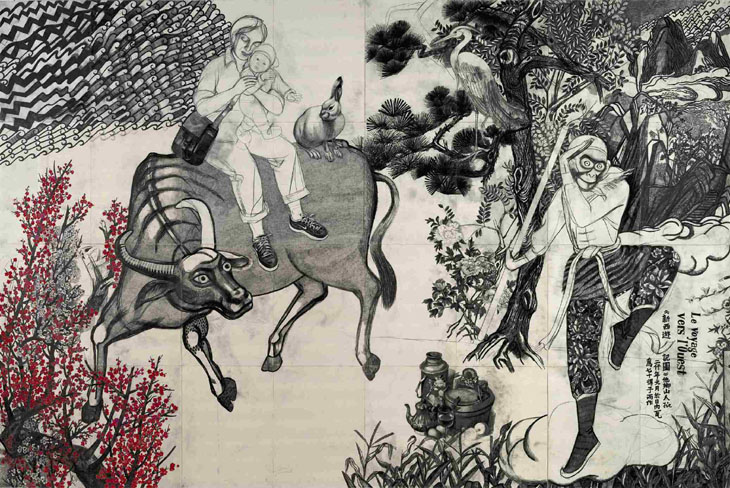
China’s authoritarian history of social control is echoed in the present day; globally, social media is providing a platform for activist narratives in art, whilst in China, there is an unsurprising hardline approach to cyber-freedom.
Many contemporary artists respond to this through the use of surveillance technologies, e.g. footage from CCTV cameras and drones, or self-surveillance to address themes of visibility asymmetries and threats to privacy. ‘Artists also engage in sousveillance, turning the gaze towards those in power, in attempts to resist surveillance and create counter-images’ (Svensson, 2016).
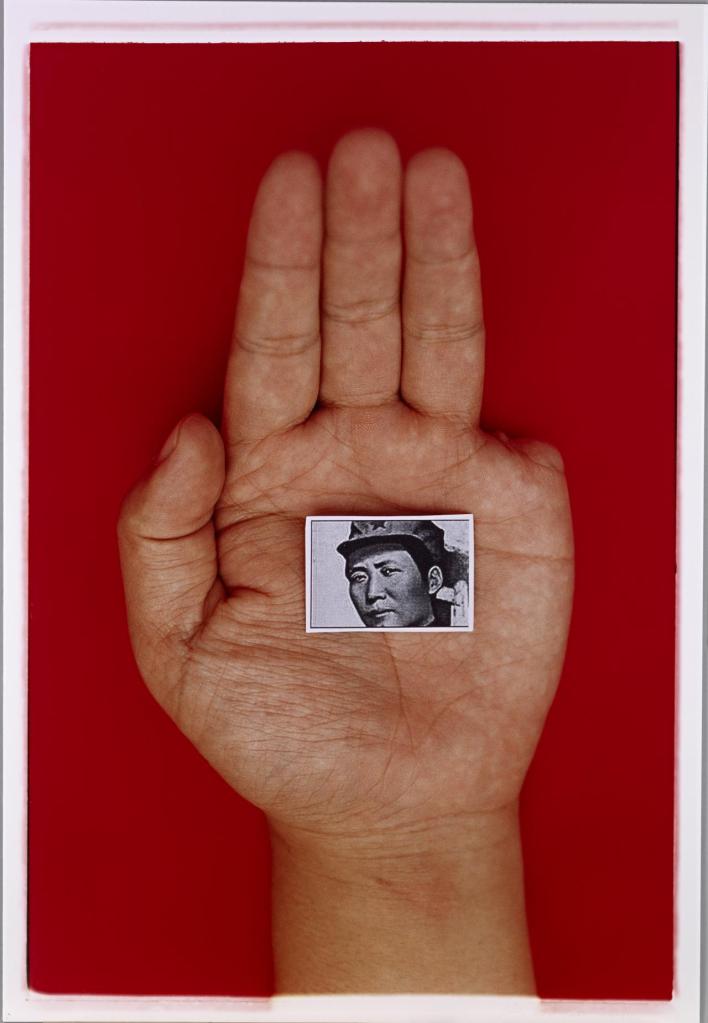
Often turning to China’s violent past, artist Qiu Jie toys with the iconic portrait imagery of Mao Zedong, and its ‘inherent and very present feelings of surveillance’ (McQuiston, 2015). Sheng Qi, too, refers to the harrowing memory of the Tiananmen Square protests to raise important and deeply personal questions regarding China today.
What is interesting, however, is that today, younger Chinese artists are reluctant to producing activist or anti-authoritarian artwork. In an interview with the New Yorker, Beijing-based artist Huang Rui states ‘young Chinese artists simply grew up in a different environment’ (2015). He, and other founding ‘Xing Xing’ members, had experienced the Cultural Revolution first-hand. Wang Keping believes that there is more repression now than in the early eighties, when ‘it seemed as though China’s economic reforms might bring about political liberalization’ (Beam, 2015). The length of the ongoing Democracy Movement has perhaps tired its relevance to younger practitioners.
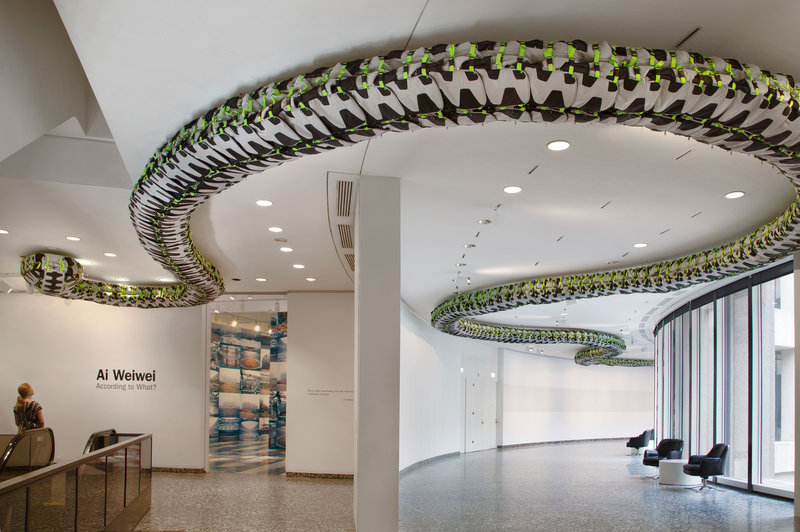
‘All but synonymous with Chinese art’ (Beam, 2015), Ai Weiwei causes great frustration to the Chinese government because of his public pursuance of injustice and incredible amount of Western attention (thanks to his social media engagement and high regard on the contemporary art scene). The former is perhaps because of his own experience of the Cultural Revolution.
Ai’s popular blog was deleted by the government in 2009; it had detailed his extensive (“citizen investigation”) research into the sub-standard quality of school buildings that led to the death of over 5,000 schoolchildren during the 2008 Sichuan earthquake.
Investigating these artists’ social engagement in this Eastern political climate highlights further complexities of the ‘hybrid’ that is artivism; firstly, that artwork acting as political commentary in an environment where this is forbidden is activist in its very existence: to create the work is to act.
Secondly, that with all the powers of digitalisation, comes a growing reliance on the cyberspace for vital information. In the case that this cyberspace is heavily monitored, if an event (or, say, a blog) can be deleted from the internet, can it be deleted from history?
‘Art, actions, events and history are obliterated… in much the same way that graffiti or street art can be painted over with lightning speed’ (McQuiston, 2015).
Sources
Books:
Mesch, C. (2013) Art and Politics. 2nd Ed. New York: I.B.Tauris & Co. Ltd.
Jelinek, A. (2013) This is Not Art: Activism and Other ‘Non-Art’. New York: I.B.Tauris & Co. Ltd.
McQuiston, L. (2015) Visual Impact: Creative Dissent in the 21st Century. London: Phaidon Press Limited.
Downey, A. (2014) Art and Politics Now. London: Thames & Hudson Ltd.
Journal articles:
Yao, Y. (2017) China’s Modern Image – Contemporary Chinese Art. Journal for Cultural Research, Vol. 21:1, pp. 51-75.
Flath, J. (2012) Art in Turmoil: The Chinese Cultural Revolution, 1966-76. University of Toronto Quarterly, Vol. 81 (3), pp. 777-779.
Hung, C. (2013) Citizen Journalism and Cyberactivism in China’s Anti-PX Plant in Xiamen, 2007–2009. China: An International Journal, Vol. 11 (1), pp. 40-54
Blogs:
Svensson, M. (2016) Surveillance and Art. In: Digital China [online]. (26th May 2020) Available from: https://digitalchina.blogg.lu.se/surveillance-and-art/
Online Newspaper Articles:
Beam, C. (2015) Beyond Ai Weiwei: How China’s Artists Handle Politics (Or Avoid Them). The New Yorker[online]. March 27 (Accessed May 26th 2020). Available from: https://www.newyorker.com/news/news-desk/ai-weiwei-problem-political-art-china
YouTube:
Action Media 2020. ActionMedia ONSITE Stars 1979 | OCAT Institute [online]. (26th May 2020) Available from: https://www.youtube.com/watch?v=Cw94PSLZUTM
ClusterAsiaEurope 2012. Chinese Propaganda: Mao’s Impact on Contemporary Art [online]. (26th May 2020) Available from: https://www.youtube.com/watch?v=X2Ep14tNj4U
Websites:
10 Chancery Lane Gallery. Wang Keping. [online]. Available at: http://www.10chancerylanegallery.com/artists/main/Wang_Keping/biography_en/ [Accessed 26th May 2020].
Future Learn. Is China a Capitalist or Communist Country?. [online]. Available at: https://www.futurelearn.com/courses/politics-of-economics/0/steps/30823 [Accessed 26th May 2020].
Online Newspaper Article:
Beam, C. (2015) Beyond Ai Weiwei: How China’s Artists Handle Politics (Or Avoid Them). The New Yorker[online]. March 27 (Accessed May 26th 2020). Available from: https://www.newyorker.com/news/news-desk/ai-weiwei-problem-political-art-china
 katebutlerart.com
You must be logged in to post a comment.